
.png)
Strength Training for Beginners: A Complete Guide
Strength training is often treated as a subcategory of general fitness, something you do with heavier weights and lower reps. That framing undersells it. Strength is a specific, trainable quality with its own rules, and training for it effectively requires understanding what separates it from training for muscle size, endurance, or general conditioning.
This guide covers what strength training actually is, the principles that make it work, and how to structure a first programme without wasting the early months on the wrong approach.
What strength training actually is
Strength is the capacity to produce maximal force, expressed as the heaviest load you can lift for a given movement. It depends on two things: how much muscle you have, and how efficiently your nervous system can recruit that muscle under load.
Beginners improve strength mostly through the second mechanism. Neural adaptations, better motor unit recruitment, improved coordination between muscle groups, more efficient movement patterns, drive most of the strength gained in the first several months of training, often before any visible increase in muscle size. This is why a beginner can add significant weight to the bar week after week without looking noticeably bigger.
The core principles
- Progressive overload - the load, volume, or difficulty of training must increase over time. Without it, the body has no reason to keep adapting. For strength specifically, this usually means adding weight to the bar in small, consistent increments.
- Specificity - strength is trained by lifting heavy. Training in the 1-6 rep range, at 80% or more of your one-rep max, builds strength more directly than higher-rep, lighter-load training, which biases more toward hypertrophy and work capacity.
- Compound movements first - exercises that recruit multiple muscle groups and joints (squat, deadlift, bench press, overhead press, row) produce more strength transfer than isolation exercises, because they train the coordination between muscle groups that strength depends on.
- Longer rest periods - 3-5 minutes between heavy sets. Strength training relies on the phosphagen energy system, which needs several minutes to substantially replenish. Short rest periods that work for hypertrophy actively undermine strength-focused sessions.
- Technical consistency - at high loads, small technical errors compound into real injury risk. Strength training rewards a stable, well-practised movement pattern over a varied one.
The essential lifts
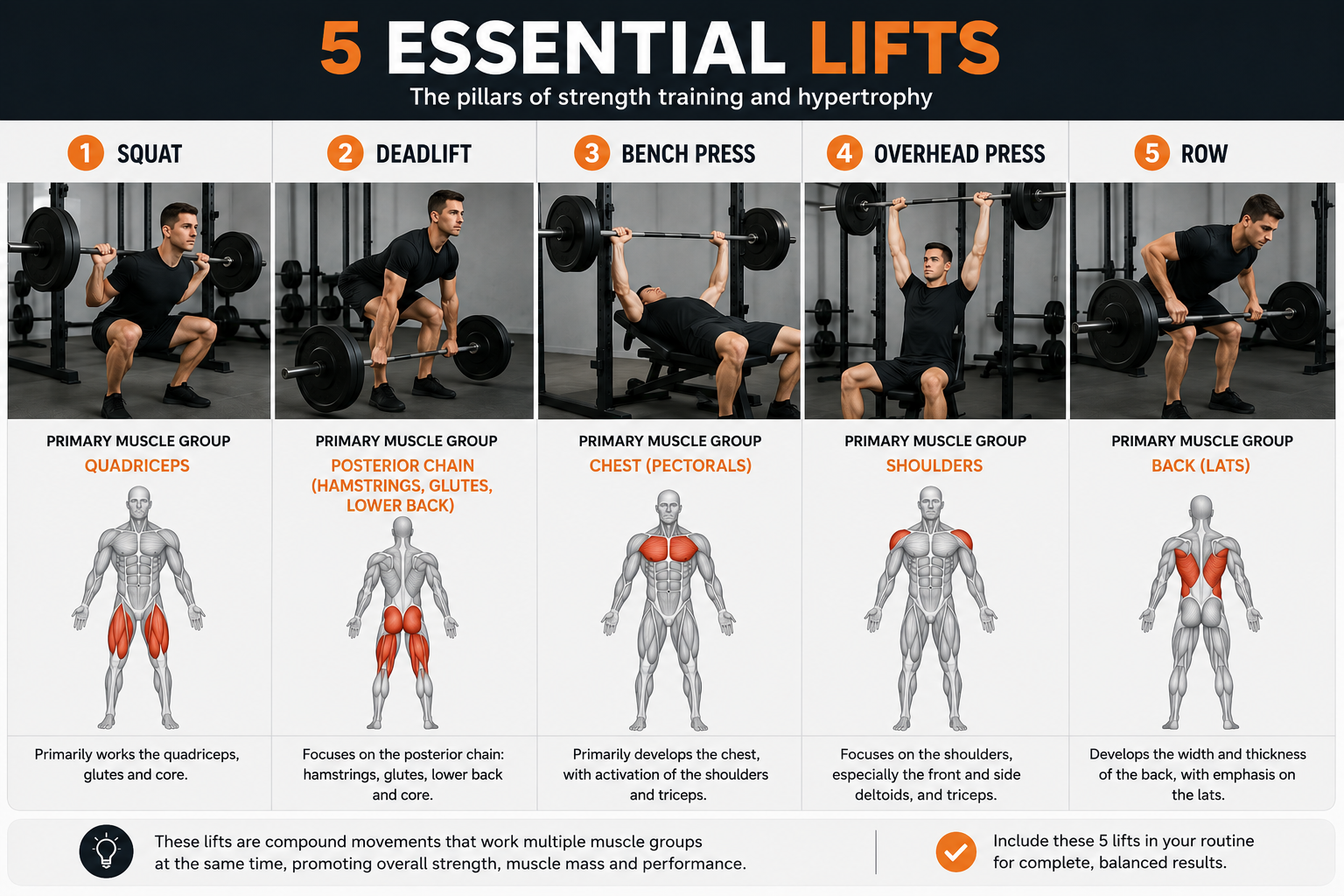
A small number of compound movements cover most of what beginner strength training needs:
- Squat - the foundational lower body movement. Trains the quads, glutes and core under load, and is the clearest single indicator of lower body strength progress.
- Deadlift - the posterior chain movement. Trains the hamstrings, glutes and spinal erectors, and typically produces the highest absolute loads of any lift.
- Bench press - the primary horizontal pressing movement. Trains the chest, shoulders and triceps.
- Overhead press - the primary vertical pressing movement. Trains the shoulders and triceps, and demands more core stability than the bench press.
- Row (barbell or dumbbell) - the primary horizontal pulling movement. Balances the pressing work and trains the upper back, which protects shoulder health over time.
A beginner programme built around these five lifts, trained consistently with a progressive loading scheme, covers the large majority of what strength training requires for the first year or more.
Strength training vs hypertrophy training: what actually differs
- Rep range - strength favours 1-6 reps at high load; hypertrophy tolerates a much wider range (6-20+) at more moderate loads.
- Rest - strength needs 3-5 minutes to allow near-maximal loads on the next set; hypertrophy needs enough rest to sustain volume, typically 60-180 seconds.
- Exercise selection - strength training centres on a small number of compound lifts trained often; hypertrophy training uses more exercise variety across a wider range of angles and equipment.
- Progression metric - strength progress is tracked primarily by load lifted; hypertrophy progress is tracked primarily by total volume.
The two are not opposites. Most well-designed programmes for intermediate and advanced lifters blend both, but a beginner benefits from understanding which one a given block of training is actually built around.
A beginner strength programme structure
A practical structure for someone starting structured strength training, three sessions a week, full body each session:
- 3 sessions per week, non-consecutive days, each session covering a squat variation, a hip-hinge or pull, and a press.
- 3-5 sets of 5 reps on the main lifts, at a load that is challenging but leaves 1-3 reps in reserve.
- Add a small, fixed amount of weight each session on the main lifts (linear progression), for as long as that progression holds.
- Rest 3-5 minutes between working sets on the main lifts.
- Insert a deload week every 4-6 weeks, or sooner if the linear progression stalls repeatedly.
This structure, often called a linear progression programme, is deliberately simple. Its value is in how directly it applies progressive overload, not in variety or complexity, both of which become useful later once linear progression stops working.
Common mistakes
- Starting with too much volume - beginners often copy advanced programmes with high set counts. Recovery capacity has not yet been built to match; fewer sets, executed consistently, beat more sets executed inconsistently.
- Chasing a one-rep max too early - testing a true 1RM before technique is consistent under load increases injury risk without providing useful information.
- Cutting rest short - resting 60-90 seconds between heavy sets, out of impatience, undermines the load achievable on subsequent sets and slows strength progress.
- Neglecting accessory and pulling work - pressing-dominant programmes that skip rows and pulling volume tend to produce shoulder issues over time.
- Changing the programme too often - strength gains, especially early on, come from consistent exposure to the same movement pattern. Switching exercises every few weeks resets the adaptation clock.
dotmoovs tracks your load, sets and reps on every lift, and shows you exactly when it's time to add weight or deload. Download the app and start your first strength programme with a system that tells you what to do next.
