
.png)
Hypertrophy Training: Rep Ranges, Volume and Rest That Actually Build Muscle
Most people training for muscle growth default to the same formula: three sets of ten, sixty seconds rest, repeat. It isn't wrong, but it isn't the whole picture either, and treating it as a rule instead of one option among several is why progress stalls earlier than it should.
Hypertrophy responds to a small number of variables that matter a lot, and a large number of variables that matter very little. Most training advice inverts that ratio. This article covers the ones that actually move the needle.
What actually drives muscle growth
Three mechanisms are generally credited with producing hypertrophy: mechanical tension, metabolic stress and muscle damage. Of the three, mechanical tension, the force a muscle produces while under load, is the primary driver. Metabolic stress and muscle damage contribute, but neither reliably produces growth in the absence of sufficient tension.
In practice, this means the single largest lever you control is how much hard, productive work a muscle does over time, not the specific rep count, tempo or exercise variation used to produce it. Volume and effort explain most of the outcome. Everything else is a second-order adjustment.
Rep ranges: why 6-12 was never the whole rule
The 6-12 rep range became the default hypertrophy prescription because it balances load and fatigue conveniently, not because it is uniquely effective. Research comparing low rep ranges (around 6-8), moderate ranges (8-12) and high rep ranges (15-30) at matched effort (sets taken close to failure) shows comparable hypertrophy across all three, provided total volume and proximity to failure are equal.
What this means practically:
- A set of 6 heavy reps and a set of 20 lighter reps can produce similar growth, if both are taken close to failure.
- Very low reps (1-5) shift the training stimulus toward strength and skill more than hypertrophy, and become harder to accumulate volume with.
- Very high reps (30+) become limited by discomfort and fatigue tolerance before they become limited by muscular effort.
- The practical range for most lifters, most exercises, most of the time is still 6-20 reps, chosen for joint tolerance and recoverable fatigue, not because anything magic happens inside that window.
The rule that matters is proximity to failure, not the number on the rep counter. A rep range is a tool for managing fatigue and joint stress, not the mechanism of growth itself.
Volume: the variable that matters most
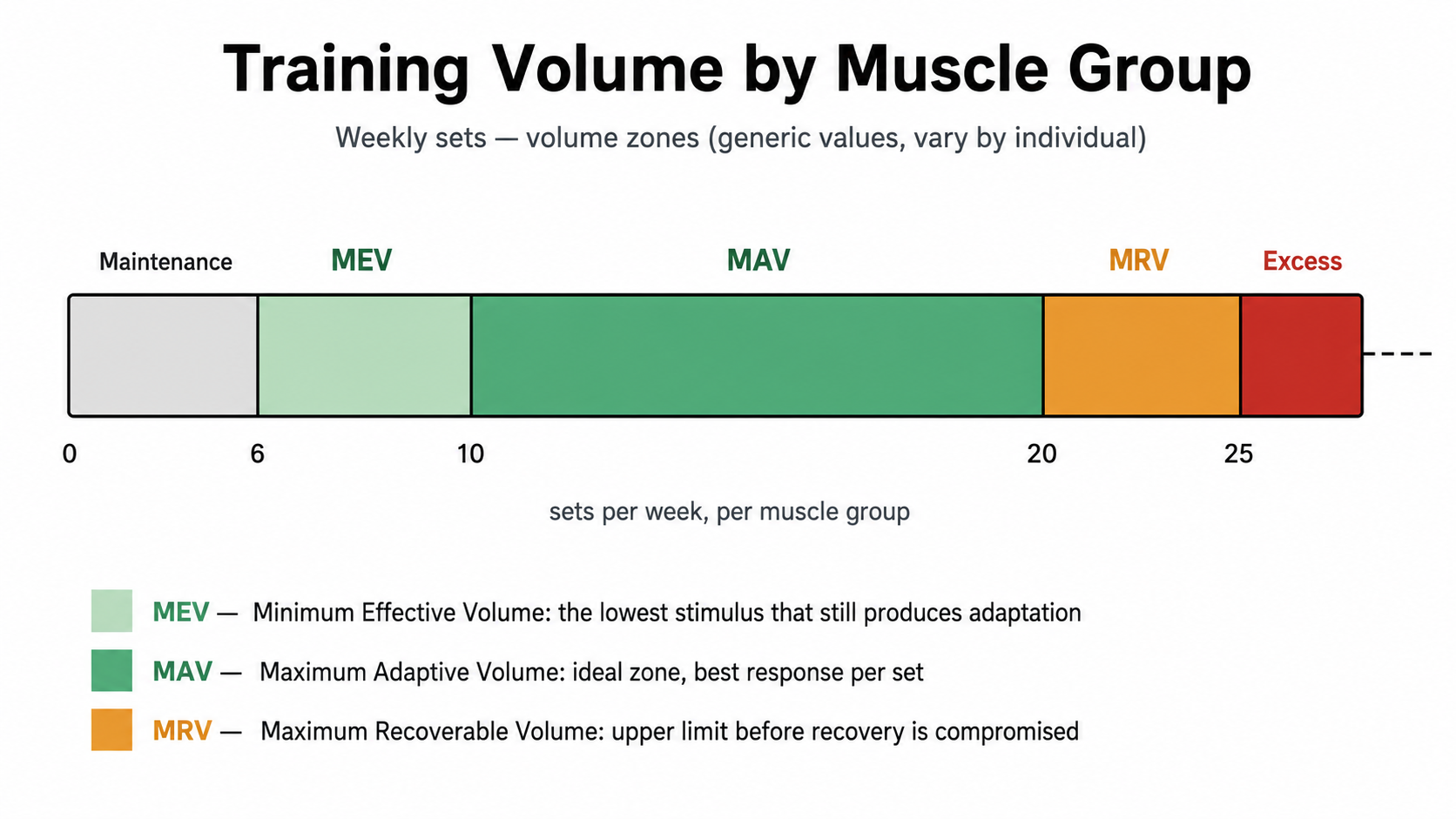
Training volume, the total number of hard sets performed per muscle group per week, is the strongest predictor of hypertrophy outcomes across the research. Three reference points are useful:
- Minimum Effective Volume (MEV) - roughly 6-10 sets per muscle per week. Below this, growth is slow or absent for most trained lifters.
- Maximum Adaptive Volume (MAV) - roughly 10-20 sets per muscle per week for most intermediate lifters. This is the range where most productive training happens.
- Maximum Recoverable Volume (MRV) - the point beyond which added volume stops producing extra growth and starts eroding recovery. This ceiling is individual and drops when sleep, stress or nutrition are compromised.
Beginners tend to grow near the bottom of this range. Volume needs to increase over months and years as the body adapts to lower workloads, which is why the same three-sets-of-ten programme that worked in year one stops working in year three.
Rest periods: recovery, not a hypertrophy switch
Rest between sets has a smaller direct effect on hypertrophy than most people assume. Its real role is enabling the next set to be performed with enough quality to contribute meaningful volume.
- Compound lifts (squat, deadlift, bench, row) - 2-3 minutes. Shorter rest reduces the load or reps achievable on the following set, which reduces total volume, the variable that actually matters.
- Isolation exercises (curls, lateral raises, leg extensions) - 60-90 seconds is generally sufficient, since the fatigue cost per set is lower and recovery between sets is faster.
Very short rest (30-45 seconds) on heavy compound work is a common mistake: it feels harder in the moment, but it caps the volume you can accumulate across the session, which is a net loss for growth.
Proximity to failure: RIR and why it matters more than the number on the bar
Reps in Reserve (RIR), the estimated number of reps left before technical failure, is a better predictor of hypertrophy outcomes than load, rep count or exercise selection individually. Most productive hypertrophy sets sit in the 0-3 RIR range.
Training consistently above 4-5 RIR (leaving too much in the tank) under-stimulates growth regardless of how correct the rep range or volume looks on paper. Training every set to true failure, on the other hand, increases fatigue cost enough to reduce the volume achievable across a session or week, which usually produces a worse net outcome than training hard but stopping just short.
Building a hypertrophy-focused week
A practical structure for an intermediate lifter training four days a week, applying the variables above:
- Distribute 10-16 hard sets per muscle group across the week rather than in a single session.
- Use a mixed rep range across exercises: heavier compound work in the 6-10 range, moderate accessory work in the 10-15 range, isolation work in the 12-20 range.
- Rest 2-3 minutes on compound lifts, 60-90 seconds on isolation work.
- Keep most sets in the 0-3 RIR range, reserving true failure for isolation exercises where the fatigue cost of missing a rep is low.
- Increase volume or load gradually over 4-8 weeks, then deload before the next block.
Common mistakes
- Chasing a rep range instead of proximity to failure - hitting 8-12 reps with 5 RIR left produces less growth than 15 reps taken to 1 RIR.
- Adding sets without tracking whether volume is being recovered from - more sets only help up to the point recovery can support them.
- Cutting rest periods to make workouts feel harder - this reduces the volume achievable per session, which works against the goal.
- Changing exercises every session - progressive overload requires a stable enough exercise selection to actually measure and add to over weeks.
dotmoovs tracks your sets, load and RIR automatically, and shows your weekly volume per muscle group so you know whether you're training in the range that actually builds muscle. Download the app and see your hypertrophy volume this week.
